
Battery Technology · Engineering View
Commercializing Anode-Free Lithium Batteries
An engineer’s view of production progress in China, the remaining limits, and where high-energy anode-free cells can make practical sense.
After roughly two years of intensive development, a few Chinese manufacturers can now produce very high-energy anode-free cells in quantity for drone applications. This was the main development I covered in our October technical briefing.
Based on our supplier discussions, I would put the number of capable Chinese producers in this particular cell class at roughly two or three. The cells discussed span 450–650 Wh/kg, but their charge rate, discharge capability, cycle life and thickness growth demand just as much attention as the headline energy density.
For now, the opportunity is in applications that value lower mass more than long cycle life.
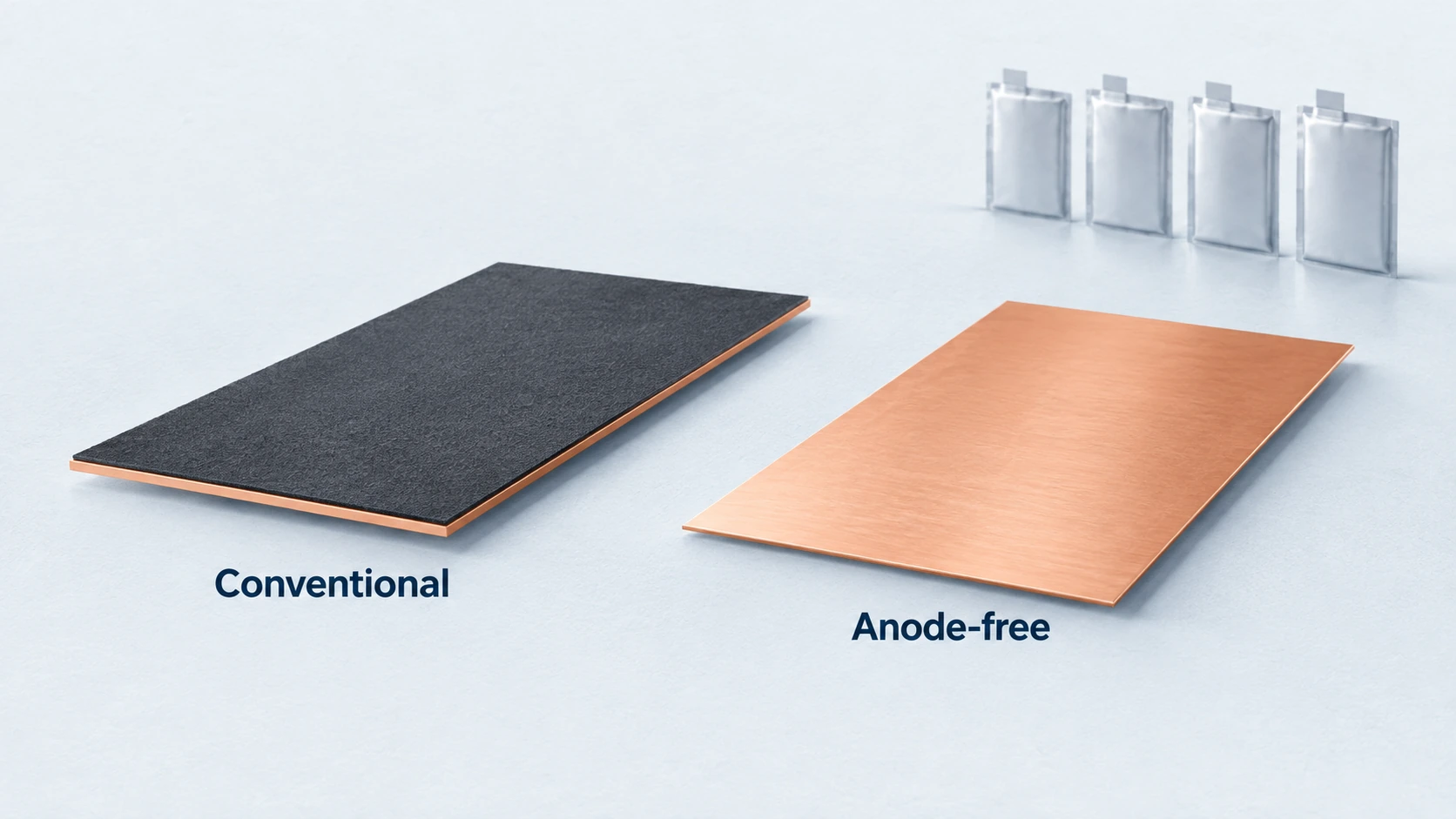
What is actually missing from an anode-free cell?
The name can be misleading. A charged anode-free battery still has a negative electrode.
In a conventional graphite-based lithium-ion cell, the negative current collector carries a graphite active-material coating when the cell is assembled. An anode-free cell starts without that conventional host layer. During its first charge, lithium leaves the positive electrode and deposits on the negative current collector, forming the lithium-metal electrode used during operation. [1]
International research generally calls this an anode-free lithium-metal battery. That is the useful term to look for when checking research or supplier documents.
At assembly
No conventional anode host layer
After the first charge
Lithium has plated on the copper
Simplified copper-based example, not to scale. Packaging, interfacial coatings and detailed electrolyte structure are omitted. “Anode-free” describes the initial assembly state.
Removing the conventional host layer saves space and mass. It also leaves the design with little room for irreversible lithium loss. Lithium consumed by side reactions, or left in deposits that lose electrical contact, is no longer available to cycle. Controlling deposition and the electrode interface is therefore central to making the architecture work. [2]
Anode-free does not automatically mean all-solid-state. It describes the electrode architecture; liquid or solid electrolyte choices are a separate question. Nor is every lithium-metal cell anode-free: some begin with a pre-installed lithium-metal foil. A high Wh/kg number alone tells us neither of these things.
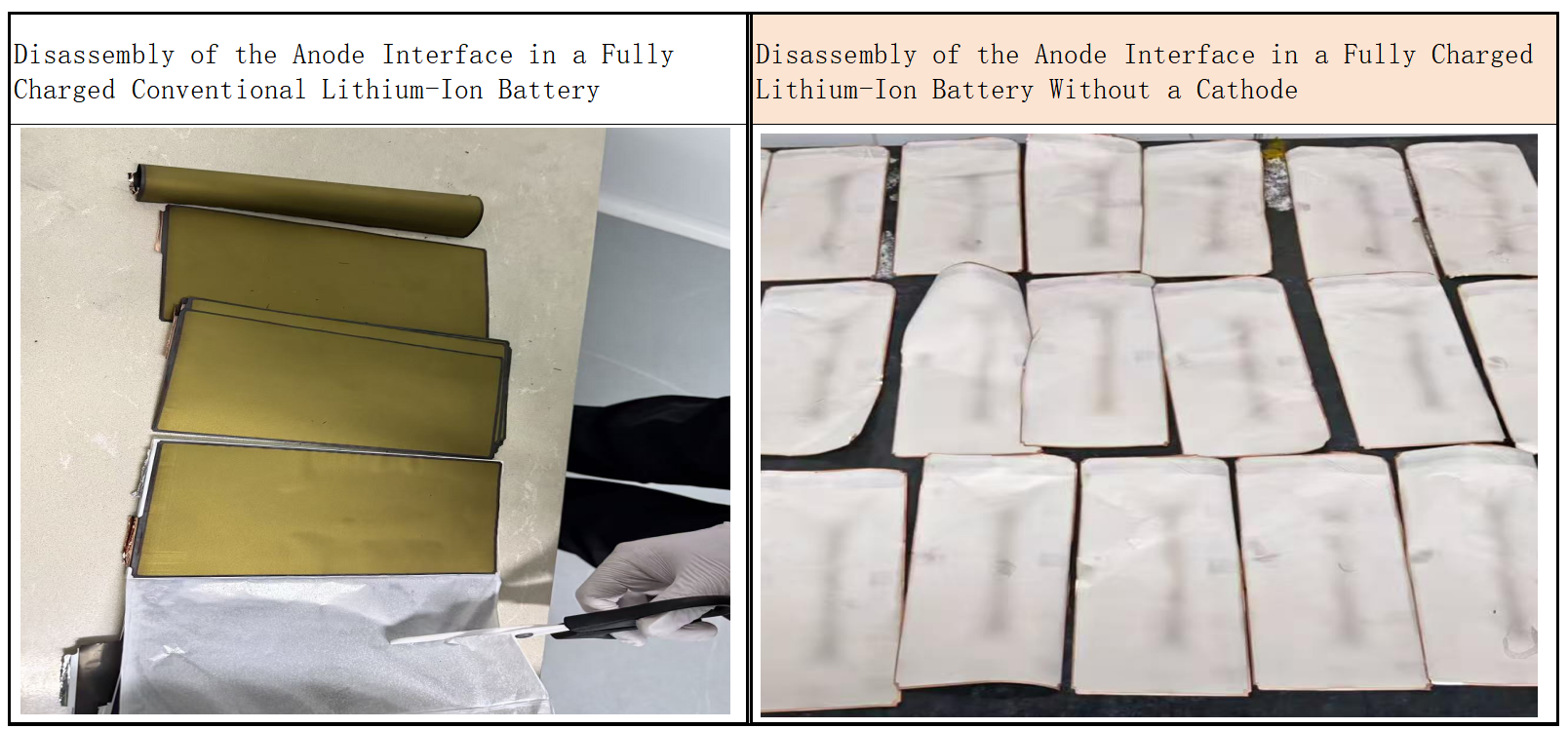
What we are seeing in Chinese production
The following figures come from the cells covered in our 15 October briefing. They describe our supplier-market observations, not specifications for every anode-free battery.
| Parameter | Reported range or limit |
|---|---|
| Cell specific energy | 450–650 Wh/kg |
| Charge rate | ≤0.5C |
| Discharge rate | ≤5C |
| Cycle life | 5–50 cycles |
| Thickness growth over cycling | ≤80% |
These figures need to be read together. At 0.5C, a full charge already needs about two hours in an ideal constant-current calculation, before allowing for the final charging taper. A discharge ceiling of 5C needs to be checked against the actual peak load. Five to fifty cycles makes replacement cost part of the mission budget. Thickness growth has to be allowed for in the pack design and retirement criteria.
The ≤80% figure is the reported thickness-growth bound for the cells discussed. It is not a recommendation to operate a battery until it reaches that point.
My view is that this is real production progress, with a narrow application window. It should neither be dismissed because the cycle life is short nor sold as a general replacement for conventional cells. The right question is whether the benefit on a particular task pays for the limitations.
The upper and lower ends of this briefing are not a combined product specification. A supplier still needs to show which energy density, rate capability and lifetime its particular model achieves under the same disclosed conditions.
How the public evidence compares
A March 2026 paper in Nature provides a clearly identified anode-free research example: a 2.7 Ah pouch cell at 508 Wh/kg. The authors report 80% capacity retention after 100 cycles at full depth of discharge, or 250 cycles at 80% depth of discharge. These are research results, not a commercial delivery record. [2]
Those results also show why our briefing’s 5–50 cycles must not be treated as a permanent ceiling for the technology. Cell design and test conditions change the result.
On the manufacturing side, QuantumScape’s Q2 2026 shareholder letter describes its automated Eagle Line as a pilot line, with output ramping and samples shipping to customers. That is evidence of industrial scale-up work, rather than proof of mature volume supply. Its technology description explicitly identifies an anode-free architecture. [1][3]
There are older large-format announcements too. ONE reported a 240 Ah anode-free cell at 1,007 Wh/L in 2022. That historical announcement does not establish that its then-planned 2026 volume-production schedule was met. Wh/L is also a volume-based measure and cannot be directly compared with Wh/kg. [4]
The public sources reviewed for this article do not independently establish repeatable commercial deliveries at 650 Wh/kg, or verify our estimate of the number of Chinese producers. Those remain our supplier-market assessment and require model-specific evidence before a purchase decision.
- 01Working cellShows the chemistry can work under stated test conditions.Research evidence
- 02Pilot productionTests the manufacturing process and supplies validation samples.Scale-up evidence
- 03Repeat deliveriesNeeds consistent lots, traceability and dependable supply.Commercial evidence
A buyer’s framework, not a claim that every supplier has reached the final stage. An energy-density announcement alone does not establish production readiness.
What still has to work on a production line
A production order requires consistency across batches, a workable pack design and an acceptable cost per mission.
First, performance must be repeatable across cells and batches. I would want to see the distribution of capacity, resistance and cycle results, not only the best-performing cell. Samples should come from the process proposed for supply, with enough traceability to investigate a later change.
Second, the mechanical conditions must survive the move into a pack. Lithium deposition and stripping change the negative electrode during cycling. Thickness measurements are only useful alongside the state of charge, cycle count, temperature and applied pressure. If a cell needs controlled pressure, that requirement belongs in the pack design from the beginning.
Finally, the manufacturing economics must hold up. Omitting a conventional anode coating does not make a finished cell cheap by itself. Formation, inspection, rejected cells and service life still affect the delivered cost. For an early high-energy product, usable missions per pack can matter more to the buyer than the factory price per kilowatt-hour.
Where I would consider these cells
Long-endurance civilian survey and inspection aircraft are sensible applications to investigate. Reducing battery mass or avoiding an extra landing may justify a more expensive, shorter-lived pack. That still depends on the aircraft’s peak current, temperature range, reserve requirement and complete pack mass.
I would be much more cautious about the cells in our briefing for agricultural spraying, training fleets or any operation built around frequent cycling and fast charging. Their working pattern asks for the very things this parameter envelope gives up.
For a project under review, I would start with the supplier’s exact cell construction and a complete test report. Then I would check energy density against the intended discharge rate, lifetime against the actual duty cycle, and thickness change against the proposed enclosure. Cell-level Wh/kg must also be recalculated at pack level after protection, interconnects, housing and mechanical allowances are included.
I would specify one of the cells in our briefing only when the validated pack-level gain justifies its shorter service life and slower charging.
If you are evaluating this route, share the application, duty cycle, mass limit, peak current and required service life with our team. Those details are a better starting point than a target Wh/kg figure alone.
Sources
- QuantumScape: battery technology and anode-free architecture FAQ.
- Liu et al., “Planar Li deposition and dissolution enable practical anode-free pouch cells”, Nature, 17 March 2026.
- QuantumScape: Q2 2026 shareholder letter, filed with the SEC.
- Our Next Energy: anode-free cell announcement, 13 September 2022.
Sources reviewed on 21 October 2026. Production observations and the parameter table come from our October technical briefing and supplier discussions; they are not Minglong test results. External results are attributed to their original authors or companies. This article does not claim that Minglong manufactures these cells or has validated a commercial model.
Jory Li
Chief Technical Engineer, Minglong Energy