
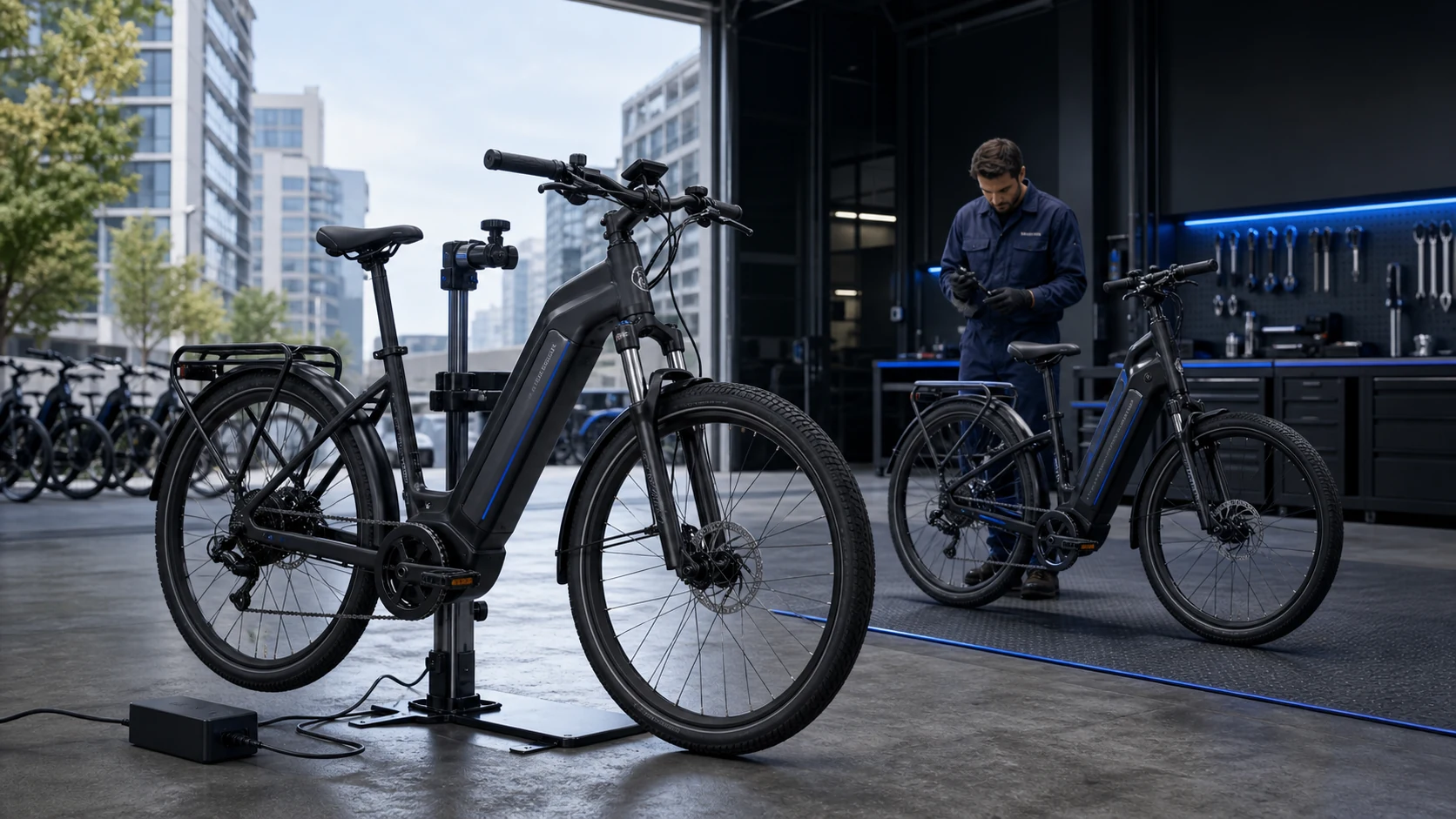
E-BIKE BATTERY APPLICATIONS
E-Bike Battery Solutions Built Around the Complete Vehicle System.
Define the bike, motor and controller, frame and lock, charger and service model first. Then coordinate the battery and validation path around the complete vehicle lifecycle.
FOUR E-BIKE PROJECT CONTEXTS
The Same Voltage Does Not Make
the Same Battery Project.
Select a project context to see its use pattern, battery priorities and validation focus. These are review starting points—not fixed battery specifications.
SELECTED CONTEXT · 01
City & Trekking OEM
Daily commuting and trekking balance usable range, vehicle mass, frame integration and predictable charging across repeated rides.
- Use & Conditions
Repeated daily trips, variable assistance and mixed urban or longer routes.
Weather, storage, rider habits and removable charging routines.
- Battery & Load
Usable range with controlled mass and clean vehicle integration.
Starts, climbs, cruising and acceleration within motor and controller limits.
- Validation Focus
Fit checks, ride-load logs, charging and vibration or weather exposure.
- Usable range
- Frame fit
- Ride consistency
SELECTED CONTEXT · 02
Cargo & Utility E-Bikes
Payload, repeated starts, grades and long working days increase the importance of voltage stability, thermal margin and enclosure retention.
- Use & Conditions
Stop-start routes, loaded acceleration, hills and extended working shifts.
Payload variance, rain, dust, curb impacts and long daily duty.
- Battery & Load
Predictable power under payload with controlled heat and voltage response.
Repeated high-demand events combined with sustained motor assistance.
- Validation Focus
Payload ride trials, temperature and voltage records, mounting and ingress checks.
- Payload
- Peak demand
- Weather exposure
SELECTED CONTEXT · 03
Authorized Brand Aftersales
Exact compatibility depends on the authorized housing, lock, connector, BMS or identity data and charger—not nominal voltage alone.
- Use & Conditions
Service replacement for defined vehicle models and production periods.
Installed base, mixed battery age, workshop handling and spare-parts life.
- Battery & Load
Documented fit and system behaviour without weakening protection.
Reproduce the original system limits and representative service conditions.
- Validation Focus
Sample comparison, fit and lock checks, charger, communication and bike-level trials.
- Authorized fit
- Interface
- Service continuity
SELECTED CONTEXT · 04
Rental & Fleet Operations
High utilization turns charging rotation, cycle tracking, serviceability and replacement planning into core battery-project inputs.
- Use & Conditions
Multiple rides per day, shared chargers and depot-based rotation.
Outdoor parking, depot charging, handling, storage and seasonal demand.
- Battery & Load
Dependable fleet availability and a maintainable service process.
Frequent partial cycles across variable riders, routes and assistance levels.
- Validation Focus
Fleet-duty reproduction, charging rotation, traceability and service trial.
- High utilization
- Traceability
- Serviceability
FROM VEHICLE DATA TO A BATTERY BRIEF
Start With How the Bike Is Built and Used.
A useful first review does not require a finished battery drawing. It does require enough vehicle, motor-system and service information to distinguish a real constraint from a target that can still move.
MOST USEFUL EARLY EVIDENCE
Ride-current logs plus an actual bike, battery and charger sample are especially useful when available.
INPUTS FOR THE FIRST REVIEW
ONE CONNECTED PROJECT PATH
From Project Input to Defined Release.
The same project information moves through one connected review path. Each step narrows uncertainty and defines the evidence needed for the next decision.
01
Project Input
Bike, motor system, range target and interface constraints.
02
Technical Review
Workable energy and mass envelope; housing, lock and system risks.
03
System Validation
Fit, ride-load, charging and vehicle-level service evidence.
04
Defined Release
Approved combinations, operating limits, records and responsibilities.
PROJECT-SPECIFIC VALIDATION
Move Forward Through
Three Clear Decision Gates.
Each stage connects the vehicle input to visible evidence and an agreed decision. Exact tests, records and responsibilities are defined for the project rather than implied as universal.
01
Agree the Vehicle & System Brief
PROJECT INPUT
Bike, rider or payload duty, motor, controller, routes, current battery and available load data.
REVIEW EVIDENCE
A shared vehicle constraint list, missing-data list and proposed review scope.
DECISION GATE
The project team agrees what must be evaluated and what remains conditional.
02
Check Pack & Integration
PROJECT INPUT
Frame space, housing, lock, connector, charger, BMS data needs and representative electrical loads.
REVIEW EVIDENCE
Project-specific fit, interface, load and temperature records where applicable.
DECISION GATE
Open integration issues are closed or explicitly carried into vehicle trials.
03
Validate Ride, Service & Release
PROJECT INPUT
Agreed vehicle, route or fleet duty, charging process, operating window and trial responsibilities.
REVIEW EVIDENCE
Recorded bike-level and service behaviour against the agreed review conditions.
DECISION GATE
Release scope, limits, approved combinations and remaining responsibilities are documented.
RELEASE SCOPE
Define What Approval Actually Covers.
PROJECT FIT
Defined B2B E-Bike Projects Come First.
Best Fit for This Page
- New e-bike platforms with accessible bike, motor and controller data.
- Authorized aftersales programs for defined brands and vehicle models.
- Rental or fleet projects with repeatable operations and meaningful volume.
- Projects coordinating housing, lock, BMS, connector, charger and validation.
Requests That Need a Different Path
- Single retail replacement-battery purchases.
- Universal-fit claims without an exact bike and interface definition.
- Unauthorized cloning, pairing bypass or removal of protection functions.
- Projects without reliable bike, charger, interface samples or data.
BEFORE A TECHNICAL REVIEW
Common Project Questions.
Can you review an existing branded e-bike?
Yes, when the project is authorized and the owner can provide reliable bike, battery, charger and interface data together with representative samples. We do not support unauthorized cloning or pairing bypass.
Are 36V and 48V the only available system options?
No. Those are common market examples, not a fixed public range. The workable system is reviewed against the motor, controller, vehicle, packaging and validation requirements.
Can an existing housing, lock or connector be reused?
Potentially, but only after checking the physical interface, sealing, electrical limits, service process and sample consistency. Nominal dimensions or voltage alone are not enough.
Can the battery use CAN, UART or other system data?
Communication and identity needs are defined project by project, including protocol ownership, required data, charger relationship, service access and validation responsibility.
START WITH THE COMPLETE VEHICLE
Share the Bike, Motor System and Service Model.
You do not need a finished battery specification. Send the exact vehicle context and the best available system data, and we can review the next technical step.
FOUR DETAILS TO START
Bike & Intended Use
Motor & Controller
Housing & Interface
Volume & Target Market
Defined B2B e-bike projects only. Compatibility, validation and market requirements remain project-specific.