
E-Bike · OEM Specification
E-Bike Battery Specification Checklist for OEM Projects
What to send, what can remain open, and what needs evidence before a battery is approved for the bike.
A voltage and capacity target is a starting point, not a battery brief. To review an OEM project, a supplier also needs to know what the pack will power, where it must fit and how it will be charged.
You can begin the discussion with incomplete information. Send the documents you have and flag the decisions still open.
This guide is for OEM and sourcing teams, not consumer battery replacement or instructions for connecting unverified components.
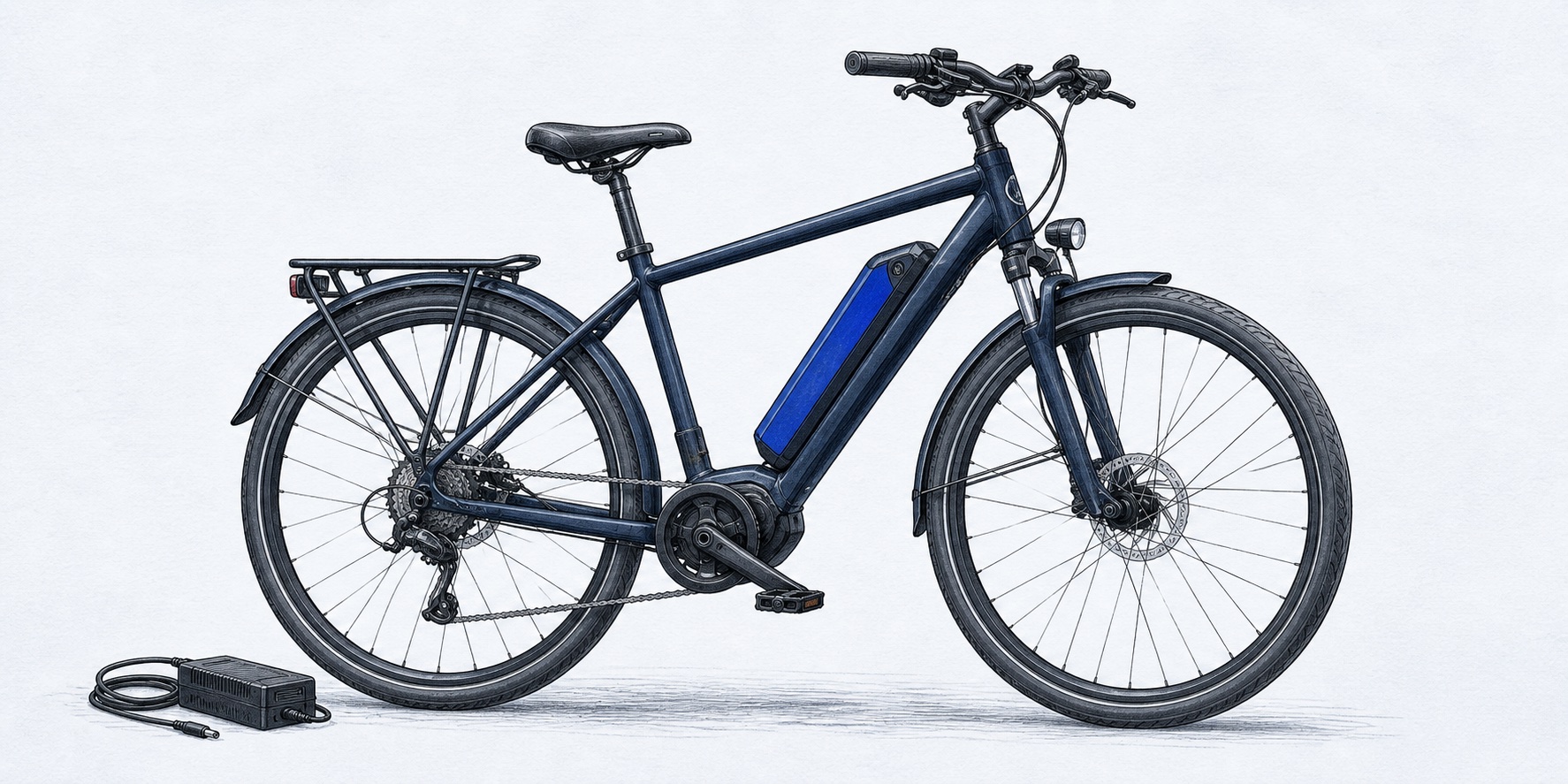
Three details that a short specification can hide
Take “48 V, 20 Ah” as an example. Those two targets leave three questions unanswered: what does the controller demand, which charger is proposed, and can the pack be fitted and removed?
1. Which current does the controller specification mean?
Ask for the controller model, its battery-side limits, and the conditions behind any continuous or peak rating. An unexplained current figure can be misleading: Grin’s Phaserunner documentation lists battery-current and motor-phase-current limits separately. Do not use the phase-current limit as the battery’s discharge requirement. This example is not a controller recommendation. [1]
If only the motor’s rated power is available, leave the controller limits open. Dividing that power by nominal battery voltage does not establish the requirement: the motor’s mechanical output and battery input are different quantities. [2]
current
current
Confirm the battery-side limits. Do not substitute a motor-phase-current rating.
Functional roles during motoring—not component locations, a wiring diagram or a rating recommendation. Based on Grin’s controller documentation.
2. Has a charging combination actually been identified?
Name the proposed charger and include its voltage, charging limits and interface information. These need to be reviewed with the battery requirements; matching-looking plugs are not evidence of compatibility.
UL Solutions addresses charger compatibility as part of the e-bike system. If the charger is undecided, mark it as open rather than simply writing “charger included”. [3]
3. Does “fits” include installation and removal?
An outline drawing may show where a battery sits without showing how it gets there. Include the mounting arrangement, latch or lock, connector access and removal direction—not just the enclosure dimensions.
Shimano’s battery-parts manual, for example, covers bracket alignment, latching and removal. Those instructions apply to the named models, not every e-bike. For your brief, the question is whether the pack can be installed, retained, connected and serviced in the intended frame. [4]
Describe the working day before fixing the capacity
Before settling on capacity, describe the ride: load, distance, gradients, assistance, speed and charging opportunities. Grin’s simulator explanation shows how weight, gradients and wind change system load. Nominal capacity alone is not a range result. [2]
Consider two planning examples. A delivery bike may make repeated loaded starts with little time between shifts; a commuter bike may need to cover a daily route before charging at home. Neither label, by itself, tells you which battery should be larger.
Also separate riding, charging and storage conditions. “Outdoor use” leaves too much unspecified; numerical limits belong in the technical review.
Ten inputs for a supplier-ready brief
Use the table to collect available information. It is a working brief, not a requirement to finish every decision before contacting a supplier.
| Input | Information to bring | Useful supporting material |
|---|---|---|
| Vehicle and use | Bike type, load and intended working day | Application brief or vehicle description |
| Controller | Model, battery-side voltage/current limits and peak conditions | Controller data and relevant settings |
| Range and duty cycle | Distance target, route, assistance and charging opportunities | Route assumptions or available duty-cycle records |
| Mechanical integration | Space, mounting, retention, connector access and removal path | Dated drawing, model or preliminary envelope |
| Charging | Intended charger and charging arrangement | Charger data and interface information |
| BMS and communication | Required protection, status reporting and device interaction | Functional requirements and interface documents |
| Environment | Riding, charging and storage conditions | Use-environment description and proposed test scope |
| Target market | Sales countries, vehicle category and responsible businesses | Market-specific documentation plan |
| Validation | What will be evaluated, by whom and against which conditions | Agreed test plan and acceptance criteria |
| Commercial lifecycle | Forecast volume, variants and service expectations | Project forecast and change-control expectations |
This is an editorial planning framework, not a test standard, certification checklist or specification for a Minglong product.
Include volume and service expectations even before pricing is settled. Label forecasts as forecasts, and distinguish sample needs from possible production demand.
Keep unknowns visible—and give them a next step
An open item is useful when it tells someone what to do next. For each input, note its status, supporting document and version, unresolved question and next action.
For example:
An open item, made actionable
Illustrative brief entry—not a real customer case
Item
Controller battery-current limit
Open
Available information
Proposed controller model; detailed limits not yet supplied
Next action
Obtain the applicable controller documentation before confirming the pack’s discharge requirement
Notice that the next action asks for documentation; it does not assign a discharge rating before that information arrives.
Use states such as Target, Document supplied, Open and Verified for the agreed conditions. They are not a fixed sequence: a drawing can be supplied while its installation assumptions remain unresolved.
For “Verified,” record the evidence for the intended configuration and conditions. Receiving a datasheet is not the same as demonstrating a result.
A first discussion is not sample approval
At first contact, you are deciding what needs review and which information is missing. Before approving a sample for use, agree on the configuration, evaluation conditions, acceptance criteria and who will carry out each check.
Market-specific checks come into that decision. In Great Britain, OPSS guidance addresses compatible-charger information, environmental protection and technical evidence. It is not an exhaustive statement of legal duties or a global certification checklist. [5]
Final requirements depend on the vehicle, configuration, sales territory and responsible businesses. This guide helps prepare that discussion; it does not approve a battery, charger combination or route to market.
Start with the information you have
Minglong Energy accepts OEM and ODM battery project enquiries. Send the application, available system documents, target market and expected volume through the project form. Include the decisions that still need review.
Source review: 3 September 2026. This research-based guide draws on the manufacturer and regulatory materials linked above. The worksheet and illustrative entry are editorial tools, not customer case studies or measured performance results.
Sources & further reading
- Grin controller documentation
ebikes.ca - Grin technical explanation
ebikes.ca - UL system-safety explanation
www.ul.com - Shimano dealer’s manual, installation section
si.shimano.com - OPSS guidance
www.gov.uk
Prepared and maintained by Minglong Energy.